This guide walks you through all 11 steps, from developing your concept to planning your grand opening. You'll get realistic cost ranges, permitting guidance, and practical advice throughout.
One thing to know upfront: customers in 2026 expect to find you online, order from their phone, and choose between delivery, pickup, or dine-in. The restaurants that are built for all three from day one are better set up than those that figure it out later. This guide will help you do exactly that.
Why opening a restaurant in 2026 requires multi-channel planning
Not long ago, a new restaurant meant a dining room, a kitchen, and maybe a takeout window as an afterthought. That model still works, but it's no longer enough on its own. Consumer behavior has shifted in ways that are hard to ignore: according to the DoorDash 2026 Restaurant Industry Trends Report, 37 million or more consumers browse delivery apps regularly, and 64% say they’d prefer a single app that handles delivery, pickup, and reservations in one place.
Setting up delivery and pickup during the planning phase is considerably less painful than adjusting a dine-in-only operation after opening.
DoorDash Marketplace can help restaurants reach customers already searching for food on DoorDash. It also gives restaurants a way to add delivery as part of their opening plan, rather than retrofitting for it later.
Step 1: Develop your restaurant concept
It starts with the concept. Your restaurant concept is the combination of your cuisine, service style, atmosphere, and target customer. It determines your menu, your staffing needs, your real estate requirements, and your price point. Get it right, and every decision that follows has a clear anchor. Get it vague, and you'll find yourself second-guessing everything from the logo to the product.
The main concept categories to choose from are quick service, fast-casual, casual dining, and fine dining. Quick service and fast-casual typically have lower labor costs, expectations for faster turnaround times, and menus built for speed and scalability. Casual dining hits the middle ground on price and atmosphere. Fine dining demands higher margins on every cover, more skilled front-of-house staff, and a customer base willing to spend accordingly.
Your concept also needs to account for delivery. Some cuisines travel well; others don’t. Think through your off-premise offering during the concept phase, not after you’ve built out the kitchen.
Step 2: Write a comprehensive business plan
A restaurant business plan isn't just a document for investors. It forces you to pressure-test every assumption about your concept before you spend a dollar.
A complete plan includes your executive summary, company description, market analysis, organizational structure, menu and service model, marketing strategy, financial projections, and funding request.
Your plan should also account for how delivery and pickup fit into your projected sales mix. Lenders and investors may want to see that you’ve considered how customers will order across channels. The right mix will vary based on your concept, location, and local demand.
If you're starting from scratch, DoorDash has a detailed guide on writing a restaurant business plan that walks through each section.
Step 3: Secure funding for your restaurant
Opening a restaurant costs more than most first-time owners expect, and running out of capital before you open is one of the most common reasons new restaurants fail.
The main funding options available to most restaurateurs are personal savings, friends and family investment, bank loans, Small Business Administration (SBA) loans, crowdfunding, and outside investors. Each has tradeoffs.
Personal savings: No debt, full control, but you carry all the risk personally.
Friends and family: Faster to access, often with more flexible terms, but can complicate relationships if things go wrong.
Bank loans: Structured repayment, potentially large amounts, but requires strong credit and often collateral.
SBA loans: Government-backed programs with favorable interest rates, designed specifically for small business owners. The SBA 7(a) program is the most commonly used by restaurant operators. They do have longer approval timelines, however.
Crowdfunding: Community-driven funding that also functions as pre-launch marketing. Caps out at smaller amounts for most campaigns.
Outside investors: Access to larger capital, but involves giving up equity and often some control over decisions.
Secure 20-30% more than your projected costs. Construction overruns, permit delays, and equipment lead times will eat into your budget faster than expected.
Step 4: Choose the right location
Your restaurant location is one of the hardest decisions to undo. A lease typically runs 5-10 years, and the surrounding neighborhood, foot traffic, and competitive density all become important components of your business model.
Seven factors matter most when evaluating a restaurant location:
Target customer proximity: Is your target demographic actually in this neighborhood? Spend time there at different hours before signing anything.
Visibility and accessibility: Can people see you from the street? Is parking available? Is there foot traffic that converts to walk-in customers?
Competition analysis: In some markets, clustering near similar concepts works. In others, saturation can be a dealbreaker.
Lease terms and costs: Monthly rent, annual escalations, build-out allowances, and maintenance responsibilities.
Zoning and permits: Not every commercial space is zoned for food service. Confirm before falling in love with a location.
Infrastructure: Ventilation, gas capacity, electrical load, and grease trap access. Retrofitting any of these is extra expensive.
Space size and layout: Does it work for your concept's seat count, kitchen, and storage needs?
Location can also affect delivery operations. In many cases, a central location may support broader delivery coverage and help make off-premise operations easier to manage. According to the DoorDash 2026 Restaurant Trends Report, 37% of consumers discover restaurants through delivery apps and 51% through Google search.
Step 5: Obtain necessary licenses and permits
Permits and licenses blindside many first-time owners. The process varies significantly by city and state and can take three to six months. Start early.
The core list includes a business license, an employer identification number (EIN), a food service license, building permits, a certificate of occupancy, a seller's permit, sign permits, and food handler permits for staff.
Food safety certification requirements vary by state, but are mandatory in most jurisdictions. At a minimum, your kitchen manager or head chef should hold a food protection manager certification. Many local health departments also require ServSafe or equivalent certification for all food-handling staff.
A note on liquor licenses: Treat the liquor license as a completely separate process. Requirements and costs vary dramatically by state and municipality. Some markets operate under a cap system with a finite number of available licenses. In cities like New York or Chicago, they can be impossible to obtain quickly or affordably. Research your specific market early and consider a licensing attorney if alcohol is core to your concept.
Step 6: Design your restaurant layout and ambiance
Layout is not just an aesthetic decision. How you arrange the dining room and the kitchen directly affects customer experience, staff efficiency, and how much revenue you can generate per square foot. A poorly designed space costs you money every shift.
Front-of-house layout
The dining room needs to balance capacity with comfort. For full-service restaurants, plan for 12-15 square feet per seat. For casual or fast-casual concepts, 10-12 square feet works. Beyond raw seat count, think about traffic flow, how customers move from the door to their table, and how servers move between tables and the kitchen without bottlenecks.
Host stand placement, bar location, and ADA accessibility all compound over time. A bar that captures walk-in traffic earns its square footage. ADA compliance built in from the start avoids expensive retrofits later.
Back-of-house layout
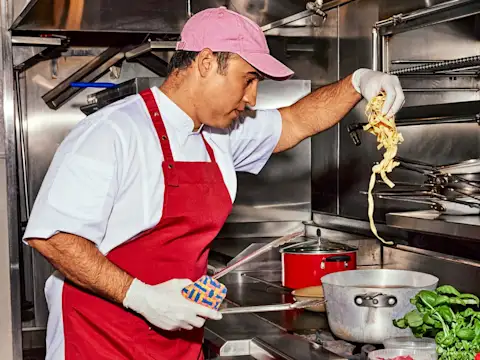
The kitchen workflow should follow a logical sequence: receiving, storage, prep, cooking, plating, service. When equipment placement respects that flow, service speeds up and errors drop.
The essential zones: cooking equipment, refrigeration, prep areas, dishwashing, and staff areas. Where you put each matters as much as what goes in it.
Plan a dedicated area for delivery and pickup orders so off-premise traffic doesn’t interrupt the dine-in experience. According to the DoorDash 2026 Restaurant Trends Report, 80% of dine-in visits and 79% of orders go to restaurants customers have visited before, so protecting that repeat experience on both channels matters.
For layout design, hiring a restaurant designer or consultant is worth the investment. Their fee is typically a small fraction of the cost of building something wrong.
Step 7: Create a profitable menu
Your menu is your moneymaker. Every item on it has a cost, a margin, and a relationship to how customers perceive your brand. A well-engineered menu reduces waste, speeds up the kitchen, and makes your margins easier to manage.
Start small. For full-service restaurants, 12-20 menu items is a proven starting range. For fast-casual concepts, 8-12. A tighter menu reduces food costs, simplifies inventory, speeds ticket times, and makes training new kitchen staff considerably less painful.
Balance matters: a mix of proteins, vegetarian and vegan options, different price points, and two or three standout signature dishes customers come back for.
The DoorDash 2026 Restaurant Trends Report found that 93% of customers chose based on detailed descriptions and 87% based on the item photo. Write good copy and take good photos — both are cheap relative to everything else in your build-out.
Menu pricing starts with food cost percentage, then adds labor and overhead. Pricing to undercut competitors rather than support your own margins is a reliable path to regret.
Think carefully about which menu items travel well. Foods that hold temperature and texture during transit are often better suited for delivery. It’s also worth investing in packaging that helps food arrive in good condition.
Need inspiration for menu design? Our guide to restaurant menu examples and how to design a menu that sells covers the strategy in detail.
Step 8: Source equipment and technology
Restaurant equipment is a significant expense, and the decisions you make affect your operations for years. Choosing the wrong equipment for your concept, or buying more than you need, is an expensive mistake. Choosing too little creates bottlenecks when your team gets busy.
Kitchen equipment essentials
Core kitchen equipment falls into a few categories: cooking equipment (ranges, ovens, fryers, grills), refrigeration (walk-in coolers, reach-in refrigerators, freezers), food prep equipment (slicers, mixers, food processors), warewashing (commercial dishwashers), smallwares (sheet pans, hotel pans, prep containers), and storage.
The buy-new-versus-used question comes up for every opening. Used equipment can save 50-70% on purchase price, but it comes with higher maintenance costs and no warranty. New equipment carries warranties and better energy efficiency, but has a higher upfront cost. Most operators land somewhere in the middle: used for workhorses like ranges and prep tables, new for refrigeration and dishwashers, where reliability is critical.
Budget guidance: depending on your concept and space size, expect to spend between $50,000 and $150,000 on restaurant equipment alone.
Point-of-sale (POS) systems
Your point of sale (POS) system processes payments, but also usually tracks inventory, manages staff schedules, generates reports, and integrates with delivery platforms. A system that can’t do all of these creates manual workarounds that cost you time and accuracy on every shift.
What to look for in a restaurant POS: ease of use under pressure, reliable payment processing, inventory tracking, reporting and analytics, and integration capabilities with delivery platforms. Cloud-based systems have become the standard because they update automatically and can be accessed remotely.
Popular restaurant POS options vary in features, pricing models, and integration capabilities. Costs typically run $50-$200 per terminal per month, with processing fees structured as a percentage of the transaction plus a small flat fee per order — check each provider's pricing page for current rates.
Planning for delivery and pickup operations
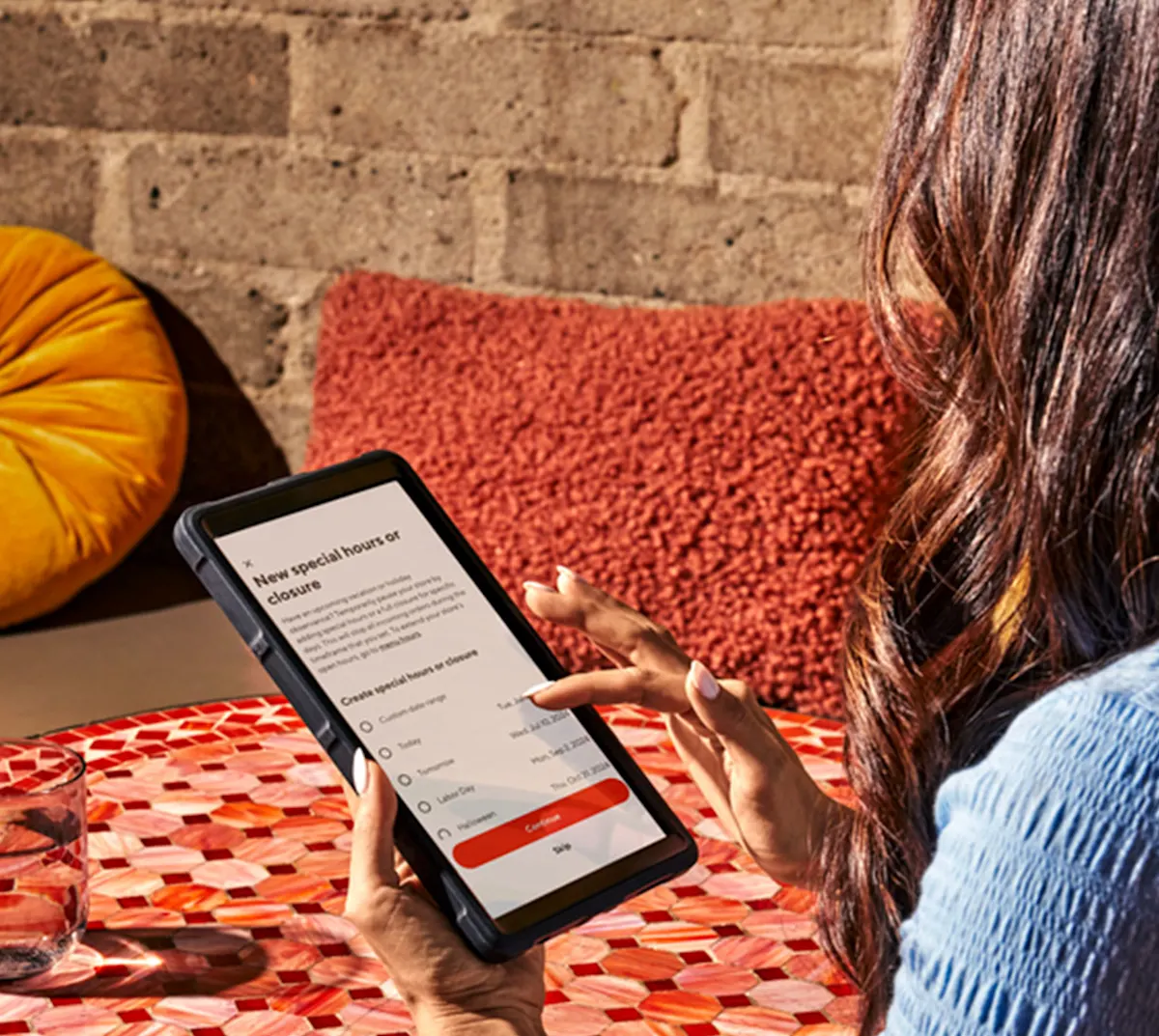
If you're launching with delivery on day one, your equipment list extends beyond the kitchen. You'll need a dedicated order management tablet, a pickup station separate from your dine-in flow, quality packaging supplies (containers, tamper-evident seals, thermal bags), and a system for routing delivery orders through the kitchen without disrupting the dine-in line.
When you sign up as a DoorDash merchant, DoorDash provides an order management tablet. If you integrate DoorDash with your POS, orders may flow directly into your existing system, which can help reduce manual entry and support a smoother workflow.
Step 9: Hire and train your team
Staff training and culture will shape the customer experience more than your menu or decor.
Core roles include head chef or kitchen manager, line cooks, prep cooks, dishwashers, front-of-house manager, servers, and a bar team if you’re serving alcohol. Start lean. It's easier to add staff as volume grows than to carry labor costs before you’re established.
Find candidates through job boards, culinary school job placement offices, and referrals.
Training should cover service standards, food safety protocols, POS, and delivery tablet operation. Train at least two or three staff on the tablet so you’re never relying on one person for that channel.
High turnover is expensive. Competitive pay, respectful management, and clear advancement paths go a long way. Building retention into your financial model is cheaper than constantly recruiting replacements.
Step 10: Market your restaurant before opening
Start building awareness well before opening night. DoorDash found that 51% of consumers find restaurants through Google search, 37% through delivery apps, and 62% through friends and family. All three require priming in advance.
Build your brand identity
Before any marketing tactic makes sense, you need a coherent brand: a name that's memorable and distinct, a visual identity that communicates your concept, and a brand voice that matches your service style.
Your website should be live with your menu, hours, location, and online ordering before you open. Set up your Google Business Profile (GBP), Instagram, and Facebook, and start posting. Behind-the-scenes content builds an audience before you have anything to sell.
Get listed on DoorDash Marketplace before you open
Consider signing up as a DoorDash merchant during the pre-opening period, so delivery and pickup are part of your launch plan from the start. To get set up, you’ll typically need your business name, address, phone number, bank details, business license and tax ID, hours, and menu.
There are no upfront fees to get started. Fees apply when orders are placed.
Pre-opening marketing can help build awareness, while a DoorDash listing gives customers another way to order once you’re live. Setting up both in parallel can help support a more complete launch plan. Sign up as a DoorDash Merchant.
Create buzz with pre-opening marketing
Social media teasers, including renovation photos, menu previews, and team introductions, build anticipation without requiring finished assets.
Local media outreach, press releases to food bloggers, and an email list started before opening can generate attention without a large budget.
Opening promotions, like a limited-time offer during the first week or a special grand opening menu, can give customers a reason to try your restaurant early. And note that 64% of customers still call restaurants to book reservations, according to the DoorDash research. Make sure your phone system is working before you open.
Step 11: Plan your soft opening and grand opening
Opening night should not be your first service. A soft opening is a 3-7 day trial run with a controlled guest list (often involving friends and family) to test every system under real conditions: kitchen throughput, service flow, POS, delivery tablet handling, and staff coordination.
Run it like a real service. Monitor ticket times, watch for bottlenecks, gather feedback from guests, and make adjustments before the broader public arrives.
The grand opening often comes 1–2 weeks after the soft opening. Promote it across every channel: social media, email, your DoorDash listing, and local press. Plan extra staffing and a special offer to drive early volume.
The first week may still bring surprises, even with strong preparation. Listen to feedback, support your team, stay consistent, and resist making major changes in the moment.
Understanding restaurant startup costs
Opening a restaurant is capital-intensive. The range is wide, and national averages can be misleading because the variables, concept type, location, city tier, and whether you're building from scratch or taking over an existing space, all move the number.
Here's what the data shows for 2025-2026:
Cost Category | Typical Range | Notes |
|---|---|---|
Leasehold improvements / build-out | $75–$250 per sq ft | Second-generation spaces cut this significantly |
Kitchen & front-of-house equipment | $40,000–$150,000 | New vs. used; hood systems alone run $10K–$30K |
Furniture, fixtures & décor | $20,000–$80,000 | Scales with concept tier |
Licenses, permits & legal | $5,000–$25,000 | Liquor licenses vary widely by state |
Initial inventory & food costs | $5,000–$30,000 | Budget for 2–4 weeks of projected costs at opening |
Working capital (3 months minimum) | $30,000–$100,000 | Covers payroll, rent, and utilities pre-profitability |
Pre-opening marketing | $5,000–$20,000 | Grand opening, digital presence, signage |
POS & technology | $3,000–$15,000 | Hardware + software; some costs shift to monthly SaaS fees |
The main cost categories to budget for:
Lease deposit and first/last month rent
Build-out and construction
Kitchen and restaurant equipment ($50,000-$150,000 range)
Furniture, fixtures, and decor
Initial food and beverage inventory
POS system and technology
Licenses, permits, and insurance
Pre-opening marketing
Working capital covering 3-6 months of operating costs
Professional fees (attorney, accountant, consultant)
Hidden costs to budget for: utility deposits, menu printing, pre-opening training, and construction delays that extend the period you're paying rent before opening. Add a 10-20% contingency.
Monthly ongoing costs include rent, labor, food costs, utilities, insurance, marketing, POS subscriptions, and loan repayments. Most restaurants don’t reach break-even within the first year, so plan your capital around a realistic 1-2 year runway.
For more on how to finance your opening, see our guide on funding for your restaurant.

Common mistakes when opening a restaurant (and how to avoid them)
Every experienced restaurateur has a list of things they wish they'd done differently. Here are the eight that come up most often.
1. Underestimating costs.
Add a 20-30% buffer to projected startup costs, secure working capital for at least three to six months of operations, and have a backup funding source ready.
2. Choosing the wrong location.
Visit at different times of day, analyze competitors nearby, and negotiate a shorter initial lease term where possible.
3. An undefined concept.
Define your target customer precisely and make sure every menu and design decision reflects that focus. See the DoorDash guide on how to design a menu that sells.
4. An overcomplicated menu.
Launch with 12-20 items for full-service, 8-12 for fast-casual. The DoorDash data shows 93% of customers choose based on detailed descriptions: fewer, better-described items outperform a sprawling menu.
5. Hiring mistakes.
Start lean, hire for attitude alongside experience, and plan for retention early– high turnover is expensive.
6. Ignoring delivery.
If delivery will be part of your business, it’s often easier to plan for it before opening than to add it later. Building delivery into your layout, staffing, menu, and technology from the start can help you avoid operational friction down the road.”
7. Skipping the soft opening.
Always run a soft opening first. The operational problems it surfaces are worth more than a few extra days of revenue.
8. Not tracking the numbers.
Use your POS reports from week one. Track food costs, labor costs, and profit margins — the numbers will tell you things instinct alone won't.
Set your restaurant up for long-term success
Opening a restaurant is genuinely hard, and genuinely worth doing. You’re building a place where people gather, eat well, and come back because something about it stuck with them. Once you’re open, our guide on how to run a successful restaurant business covers what it takes to sustain the momentum past opening day.
Customers increasingly want the flexibility to dine in, order delivery, or pick up. Restaurants that plan for all three early may be in a stronger position as ordering habits continue to evolve.
DoorDash Marketplace can help restaurants reach customers ordering on DoorDash. Delivery orders are fulfilled through Dashers, and customers can track their orders in the DoorDash app.
You can sign up without upfront fees and make DoorDash part of your launch plan. For restaurants preparing to open, it can be a practical way to add delivery and pickup alongside dine-in from day one.