Most restaurant owners turn these over in their heads, one at a time, never on paper. This guide hands you a tool to lay them out together and see how they connect. You'll follow a clear, step-by-step process, then fill in a free template built for your own restaurant.
What is a SWOT analysis for restaurants?
SWOT stands for Strengths, Weaknesses, Opportunities, and Threats. It's a way of taking stock of your restaurant from four angles at once.
The first two sit inside your four walls, and both are yours to change. Strengths are what you do well, like a packed patio every Friday or a regular crowd that knows your name. Weaknesses are where you fall short, maybe a cramped kitchen or wait times that stretch on busy nights.
The last two come from outside, where you have less control. Opportunities are openings you can move on, like a wave of delivery demand in your neighborhood or a competitor closing down the block. Threats are what could hurt you, whether that's economic downturns like rising beef prices or a new chain opening nearby.
Whether you run a solo-owner diner, a busy taqueria, or a growing fast-casual spot, a proper SWOT analysis points you toward a smarter next move.
Why every restaurant should do a SWOT analysis
According to the DoorDash 2026 Restaurant Trends Report, nearly 1 in 5 operators can't identify the same customer across on- and off-premise interactions. Close to one-third find it hard to connect guest data across channels.
A SWOT analysis won't fix that disconnect on its own. What it does is surface the problem, along with others like it, so you can see clearly and decide what to do next. It diagnoses; it doesn't cure.
Spot problems before they get expensive. Catching a margin squeeze early costs far less than untangling a cash flow crisis later.
Find growth you've been overlooking. Whether that's delivery, catering, a new daypart, or a menu pivot.
Make sharper, more informed decisions. Know exactly where to put your time and money.
See how you stack up against competitors. Find out where you have a competitive edge.
If you're thinking about launching on DoorDash Marketplace, complete a SWOT analysis first to figure out whether delivery fits your operation right now.
How to do a SWOT analysis for your restaurant (step by step)
Step 1: Gather your team
Set aside one to two hours. Block it out like any other business meeting.
Keep it collaborative. Pull in people from the front of house, back of house, and management. Your server is closest to the customer experience. Your line cook knows which menu items cause delays or come out inconsistent.
Step 2: Define your objective
Every item you add to the grid should connect back to this objective.
First, agree on what you're trying to figure out. The more specific your objective, the more useful the analysis. "Improve the restaurant" is too broad. Something like "decide whether to launch delivery this quarter" or "figure out why weeknight sales dropped 15%" gives the exercise direction.
Step 3: Create your SWOT matrix
Collect supplies to create a real-life map.
Draw a simple two-by-two grid on a whiteboard or a sheet of paper, or use our free template.
Label the four quadrants: Strengths, Weaknesses, Opportunities, Threats. Don't overthink the format, just start a brainstorming session through each step below.
Step 4: Identify your restaurant’s strengths
Start with what your restaurant does well.
These are internal factors, the things you control and that set you apart. Ask the team: What do regulars mention in reviews? What keeps people coming back? What do you do better than the place down the street?
Strengths often look like:
A loyal customer base and strong word-of-mouth reputation
A signature dish or unique cuisine that competitors can't easily replicate
A prime location with strong foot traffic or easy parking
Low staff turnover and a consistent, experienced kitchen team
Strong ratings and an established presence on DoorDash Marketplace
Step 5: Identify your weaknesses
Be honest about where you fall short.
Ask the team: Where do things fall apart during a rush? What do negative reviews keep bringing up? What's slowing us down or costing more than it should? Where aren’t we listening to customer feedback?
Encourage transparency; vague answers won't make your restaurant better or improve your business strategy.
Weaknesses might include things like:
High food or labor costs squeezing your profit margins
Long wait times or inconsistent service during peak hours
No online ordering or delivery option, so customers who want it go elsewhere
Equipment overdue for an upgrade that's hurting food quality or kitchen speed
Heavy dependence on one or two key staff members who could leave
Step 6: Identify your opportunities
Pinpoint gaps in the market that you're able to provide.
Look at what customers are asking for, where local competitors fall short, and which tools or channels you haven't explored yet.
A few common ones:
Growing demand for delivery and takeout in your area
A gap in the local market, with no one nearby doing your cuisine or price point
Menu trends your current offering doesn't cover, like plant-based, gluten-free, or other dietary-friendly options
Untapped revenue streams like catering, private or community events, or meal kits
Running a first Promotion or DashPass offer through DoorDash Marketplace to bring in new customers
The DoorDash 2026 Restaurant Trends Report found 74% of dine-in consumers later ordered delivery from the same restaurant, and 62% of delivery consumers later dined in. If you're not yet active on both channels, it's time to consider it.
Step 7: Identify your threats
Brainstorm external factors that could hurt your business.
This isn't an invitation to scare yourself, but rather to prepare for the unexpected. Spotting a threat early gives you a head start on responding to it.
Threats to keep on your radar:
New competitors opening nearby, or delivery-only concepts moving into your area
Rising ingredient costs or supply chain disruptions affecting your key menu offerings
Labor shortages and minimum wage increases pushing up staffing costs
A shift in customer habits, with fewer dine-in occasions and more price sensitivity
Negative online reviews or a viral social moment that dents your reputation
Step 8: Analyze and prioritize your findings
Once all four quadrants are full, step back and look for the intersections.
Start with weakness-threat pairs. These are likely urgent, as weaknesses will get worse under specific threats. Then evaluate your strength-opportunity pairs, where something you do well aligns with an opening in the market. This is an opportunity for growth.
FYI: You don't have to act on everything. Pick two or three priorities and build an action plan around them.
Restaurant SWOT analysis template
You've seen what goes in each quadrant. Now you need somewhere to put it. The template below lays out all four sections on a single page, so your whole team can work from one view during the meeting.
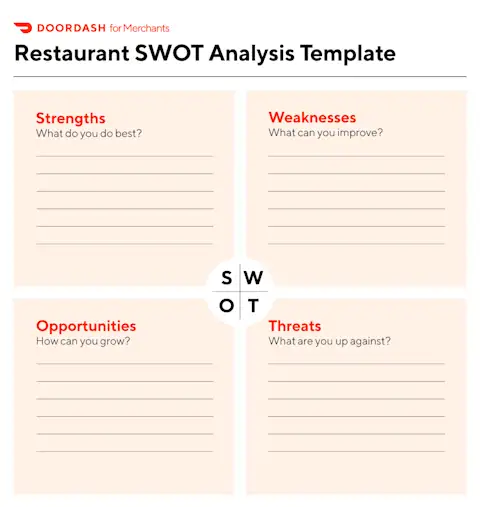
Print one copy for the group or fill it in on a shared screen. Start with strengths to build some momentum, then work through the rest.
Download the free DoorDash SWOT template and keep it somewhere you'll revisit as things change.
Restaurant SWOT analysis examples
A SWOT analysis looks different depending on what you're running. A white-tablecloth restaurant and a busy taco counter face different pressures and chase unique opportunities.
Watch how the same analysis leads three restaurants somewhere completely different.
Example 1: Fine dining restaurant
Strengths: A reputation built over years, hospitality guests remember, and a loyal base of high-spend regulars. A deep wine program and a tasting menu set the room apart from anywhere else in town.
Weaknesses: High operating costs on every cover, from labor to ingredients. The concept doesn't travel, so delivery isn't an option, and the whole model leans on one narrow slice of the market.
Opportunities: Room to grow without cheapening the brand. Private dining, corporate bookings, and chef's table experiences all extend what the kitchen already does well, at a premium.
Threats: A pullback in discretionary spending hits high-end dining first. And every comparable restaurant nearby is courting the same limited pool of high-spend diners.
The action: Build out a private dining and events package. Start with one recurring format, like a monthly winemaker dinner or a set-menu tasting available by reservation, and track that revenue separately from regular service so you can see what it adds.
Example 2: Casual dining restaurant
Strengths: Broad menu appeal that suits a table of picky eaters, flexible seating for groups of any size, and a place in the community. Families and regulars come back week after week.
Weaknesses: The model lives and dies by table turnover, so a slow night hits hard. With no delivery in place, every customer who'd rather eat at home goes to someone else.
Opportunities: Delivery is the obvious next step, and the kitchen is already built for it. A loyalty program could bring regulars back more often and lift the average check.
Threats: Fast-casual spots keep nibbling at the same price point, and labor costs climb each year whether sales follow or not.
The action: Set up delivery on DoorDash Marketplace with a focused menu of 15 to 20 items that travel well. You're already cooking the food, so this brings in extra revenue with little added complexity.
Example 3: Quick-service restaurant (QSR)
Strengths: Speed, first and foremost. A price point that holds up when customers tighten their budgets, and a streamlined menu the team executes the same way every shift.
Weaknesses: Margins are thin enough that any cost increase stings. The draw is fast, affordable food rather than a memorable night out, which makes loyalty harder to earn.
Opportunities: Delivery fits QSR naturally, since the food is built to travel. Off-peak promotions can fill the quiet hours when the kitchen sits half-idle.
Threats: National chains compete hard on the same speed and price, with budgets a single location can't match. Minimum wage increases press on already-tight labor costs.
The action: Test a DashPass promotion during off-peak hours to drive extra orders when your kitchen has capacity. Track average order value so you can confirm delivery stays profitable after fees.
When to do a SWOT analysis for your restaurant
A SWOT pays off most when something is about to change, in addition to your yearly restaurant maintenance cycle. Treat it as the first step in a big decision.
A new competitor opens nearby. Before you react, map what they've got and what you still do better.
You're weighing a second location. Pressure-tests whether the strengths carrying your first location will travel to the new restaurant.
You've had three slow months in a row. A pattern that long points to something structural, and the grid helps you find it.
You're about to launch on a new platform like DoorDash Marketplace. Run the exercise first to confirm delivery fits your operation before you commit.
You're planning a menu overhaul or concept change. Know your strengths before reengineering your menu or restaurant concept.
Turning your SWOT findings into an action plan
You've filled in the grid. Now it's time to act. Here's how to turn your results into a working plan.
Start with the pairs you flagged in Step 8. Take the two or three that carry the most weight, the near-term risks and the clearest growth bets, and leave the rest for later.
Set a specific goal for each. Vague intentions won't help you advance. "Improve our delivery presence" should be "Launch on DoorDash Marketplace by [date] with a 15-item menu." Make it specific enough that you'd know whether you hit it.
Assign ownership. Shared responsibility generally means no responsibility. Using names, assign a specific action to each person on your team.
Set a review date. Identify a specific date six months out to return to the grid, update it, and reset your priorities.
Grow your restaurant with DoorDash
Many restaurants see delivery somewhere in the SWOT, whether as an opportunity to chase or a weakness to fix. Either way, the next move is getting it off the ground. DoorDash Marketplace is the quickest route to your first delivery order. You can be live within a week, with no long-term commitment required.
Already on Marketplace? Put your SWOT findings to work in your Merchant Portal dashboard. Check your reorder rate, run a Promotion on the items your team flagged as strengths, and use Sponsored Listings to gain visibility in the categories where you spotted a local opening.